
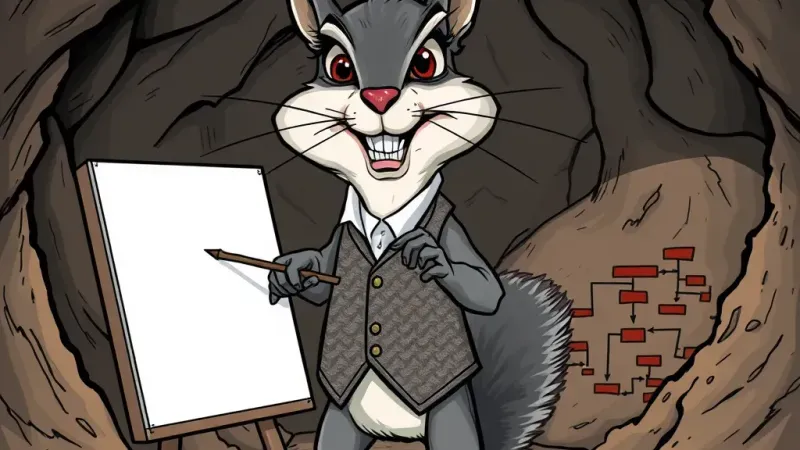
A groundbreaking field study published Tuesday revealed that North American woodland creatures have officially abandoned traditional survival strategies in favor of a venture-backed, multi-partner lifestyle optimization model that looks remarkably like a downtown Brooklyn co-working space. According to the report, local squirrels, voles, and woodland mice are no longer relying on simple nut-burial tactics, but have instead transitioned to high-yield communal food storage systems paired with ethically non-monogamous winter mating structures.
"For decades, we labored under the naive assumption that a squirrel simply buried an acorn in the dirt because it was hungry," said lead behavioral ecologist Dr. Harold Vance, gesturing toward a complex whiteboard diagram mapping out a tangled web of romantic entanglements and shared pantry logistics among a family of eastern gray squirrels. "What we are actually seeing is a sophisticated, decentralized foraging DAO. These animals aren't just storing calories for the winter frost. They are leveraging emotional diversification to hedge against systemic seed-crop failure."
The study highlights three distinct species that have successfully integrated modern dating philosophies into their hibernation routines. Leading the pack is the common field mouse, which has reportedly discarded the nuclear family structure entirely. Instead, individual mice now maintain concurrent romantic partnerships across three separate hedgerows, effectively pooling caloric assets into a centralized underwater refrigerator—constructed out of hollowed-out gourds submerged in local creeks—to maximize long-term nutritional liquidity.
"Back in my day, a mouse found a piece of cheese, brought it home to his wife, and starved to death in a damp hole like God intended," muttered retired game warden Thomas Miller, watching a chipmunk meticulously update a shared Notion spreadsheet regarding blackberry distribution rights. "Now these little bastards are holding quarterly syncs, discussing resource sharing, and rotating partners every Tuesday. It’s disgusting. Whatever happened to good old-fashioned mammalian despair?"
Wildlife authorities note that this behavioral shift is driven largely by the harsh economic realities of the modern forest floor, where rampant inflation of pinecone prices and skyrocketing oak tree rent have made single-income survival nearly impossible. By embracing polyamory, woodland animals can distribute the cognitive and physical load of gathering winter provisions across multiple partners, while simultaneously maintaining a diverse network of backup pantries should one particular boyfriend get eaten by an owl.
"The traditional monogamous winter stash is fundamentally broken," explained a spokesperson for the National Wildlife Federation, speaking on condition of anonymity. "If your sole romantic partner gets intercepted by a predatory hawk in November, your entire caloric portfolio collapses. Polyamory isn't just an alternative lifestyle choice anymore; it's a vital financial hedge against the inevitable horrors of the natural world."
Critics of the study, however, argue that projecting human relationship dynamics onto wild animals is both scientifically dubious and deeply projecting. Conservative wildlife organizations have already begun pushing back against what they term 'woke biology,' insisting that squirrels operate best under traditional Judeo-Christian values of hard work, private property, and aggressively hoarding nuts away from their neighbors until they completely forget where they put them.
Despite the ideological pushback, the trend continues to spread rapidly across multiple ecosystems. Conservationists report that beavers in the Pacific Northwest have recently begun experimenting with open-relationship dam construction, bringing in outside contractors from neighboring river systems to help manage timber flow while their primary domestic partners spend the winter months exploring their individual identities in a different pond.
As winter approaches, researchers predict that even more species will adopt these advanced lifestyle frameworks. Experts believe that by next season, migrating geese will likely ditch traditional V-formations in favor of a flat-hierarchy, decentralized leadership structure where no single bird is forced to bear the emotional burden of leading the flock south for the winter.