
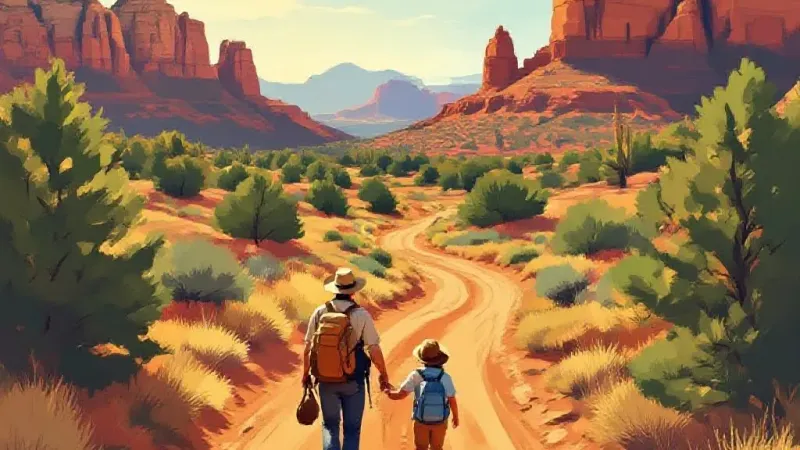
Brothers Troy and Gil Gillenwater traversed 810 miles across Arizona, from the Mexican border to the Utah line near Kanab, between Feb. 28 and May 3, 1982. This extensive journey, undertaken with two mules, a shotgun, two pistols, and maps, served as a foundational inspiration for the collective imagination that ultimately led to the establishment of the Arizona Trail. Their adventure was recently highlighted in the new documentary "Trailblazers," which was screened at the Sedona International Film Festival on Wednesday, Oct. 14, and is scheduled for a forthcoming showing in Cottonwood.
The Gillenwater brothers, then 21-year-old Troy and 28-year-old Gil, spent two years preparing for their expedition. They began their journey in Guadalupe Canyon, opting to use their 900-pound mules, named Grandma and Judy, to carry their equipment. This choice was deliberate, as Troy Gillenwater explained, allowing them more independence from water sources, noting that "in Arizona, wherever there’s water, there’s people." The trek was described by Troy Gillenwater as involving roughly equal parts of bushwhacking, established trails, and dirt roads. He cautioned that perceived shortcuts often proved costly.
Beyond ranchers and smugglers, who were sometimes less than welcoming to the brothers crossing their land, their most notable companion was a stray dog named Boogers. The dog began following them out of Willcox, persisting despite the brothers' limited food supply. Gil Gillenwater recounted a moment when he called to the dog in Spanish, "ven aqui," and it responded. While Gil attempted to domesticate Boogers after the journey, the dog repeatedly escaped, with Troy Gillenwater concluding that he "was meant for the outdoors." The brothers also carried a journal, a camera, jeans, sneakers, and a proclamation from then-Arizona Gov. Bruce Babbitt.
Approximately halfway through their journey, the brothers rested at the cabin of Curly McKibbey in the Bradshaw Mountains near Humbug Creek. Curly, a hard-rock miner who had been panning for gold in the area since the 1950s, was an acquaintance of Troy Gillenwater from his teenage years and traded gold nuggets for groceries in Rock Springs. This cabin was one of only two fixed points on their route, the other being Black Bridge, which spans the Colorado River in Grand Canyon National Park. From McKibbey's cabin, their path continued north through Williams to the Grand Canyon's South Rim. At this point, the mules could no longer proceed and were sent to be boarded in Camp Verde. The brothers continued on, technically sending their backpacks into Utah before they themselves crossed the state line on May 3, 1982.
Reflecting on the completion of the arduous trek, Gil Gillenwater noted the profound simplicity found in the daily rhythm of putting one foot in front of the other, calling it "liberating." Troy Gillenwater echoed this sentiment, emphasizing that "everything changes." He explained that even challenging conditions, such as freezing cold, are not permanent, reinforcing the importance of perseverance. The lessons learned during their walk across Arizona, Troy Gillenwater stated, served them well for four decades, influencing their subsequent global adventures in places like Ethiopia, Eritrea, South America, and the Himalayas.
The brothers continued their adventurous spirit, including an expedition to Tibet with their youngest brother, Todd, where Troy Gillenwater acknowledged their mutual reliance. In 1987, a wrong turn while traveling to Nogales led the Gillenwaters to establish the Rancho Feliz Charitable Foundation. This Phoenix-based nonprofit focuses on building homes, education centers, and childcare facilities in Agua Prieta, Mexico. That same year, the brothers also rafted 500 miles of the Colorado and Green rivers.
The Gillenwater brothers, alongside Dale Shewalter, known as the Father of the Arizona Trail, are credited with inspiring the vision of what such a statewide path could be. Robert Stieve, editor of "Arizona Highways" magazine, noted that the Gillenwaters' route followed much of the Arizona Trail as it exists today, stating they aimed to "walk back in time a little bit" and follow in the footsteps of pioneers and natives. The Arizona Trail, traversing the state, was completed in 2009 and later received a National Scenic Trail congressional designation.
The documentary "Trailblazers," directed by Kristin Atwell, aims to support the Arizona Trail Association. Atwell, who considers the Gillenwaters her "big-brother role models in adventure," affirmed that "when you commit yourself, good things happen." The film's next screening is scheduled for Monday, Nov. 2, at 7 p.m. at Old Town Center for the Arts, located at 633 N. Fifth St., Cottonwood. This event benefits the Arizona Trail Association Endowment, which ensures the long-term maintenance of the Arizona Trail.